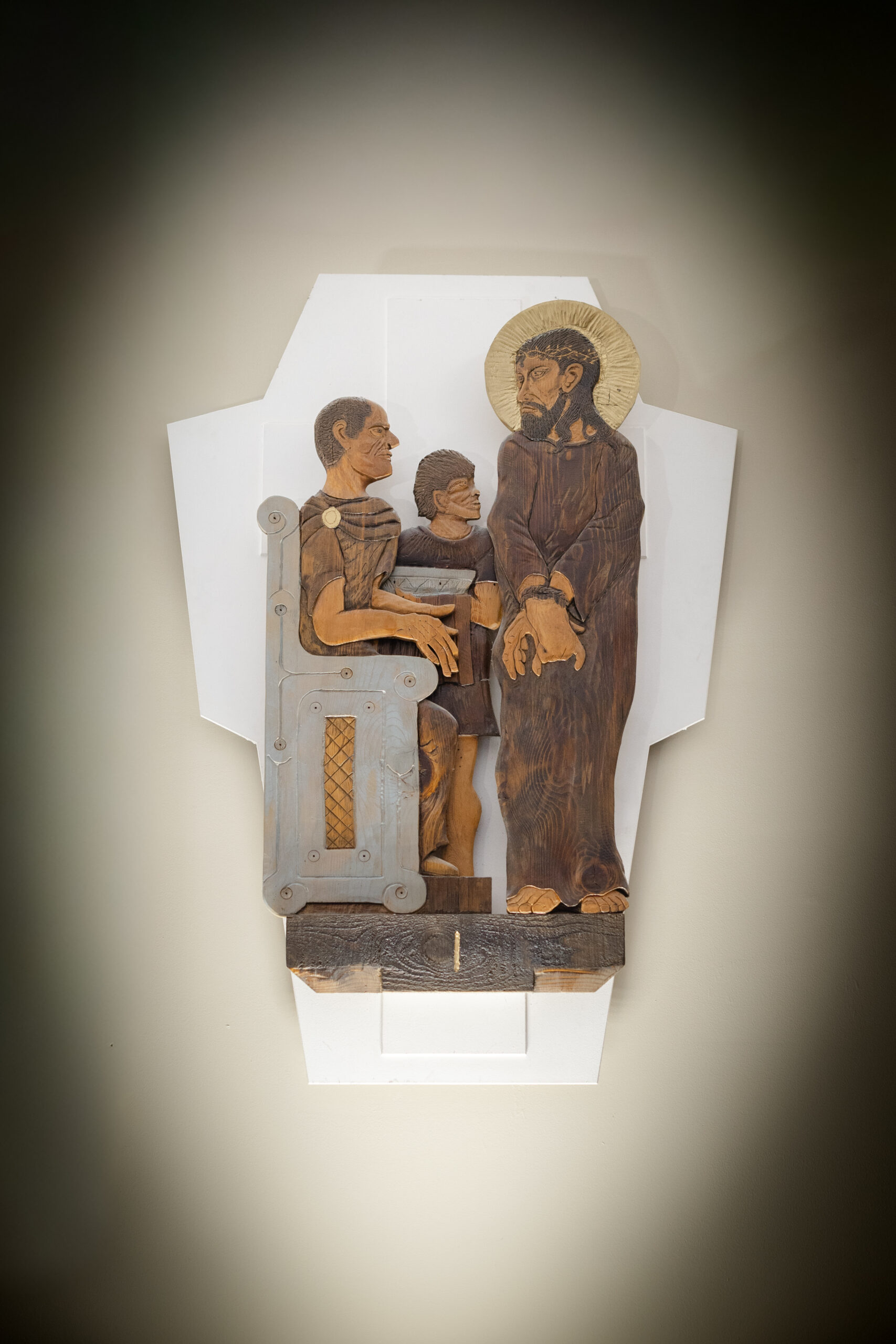


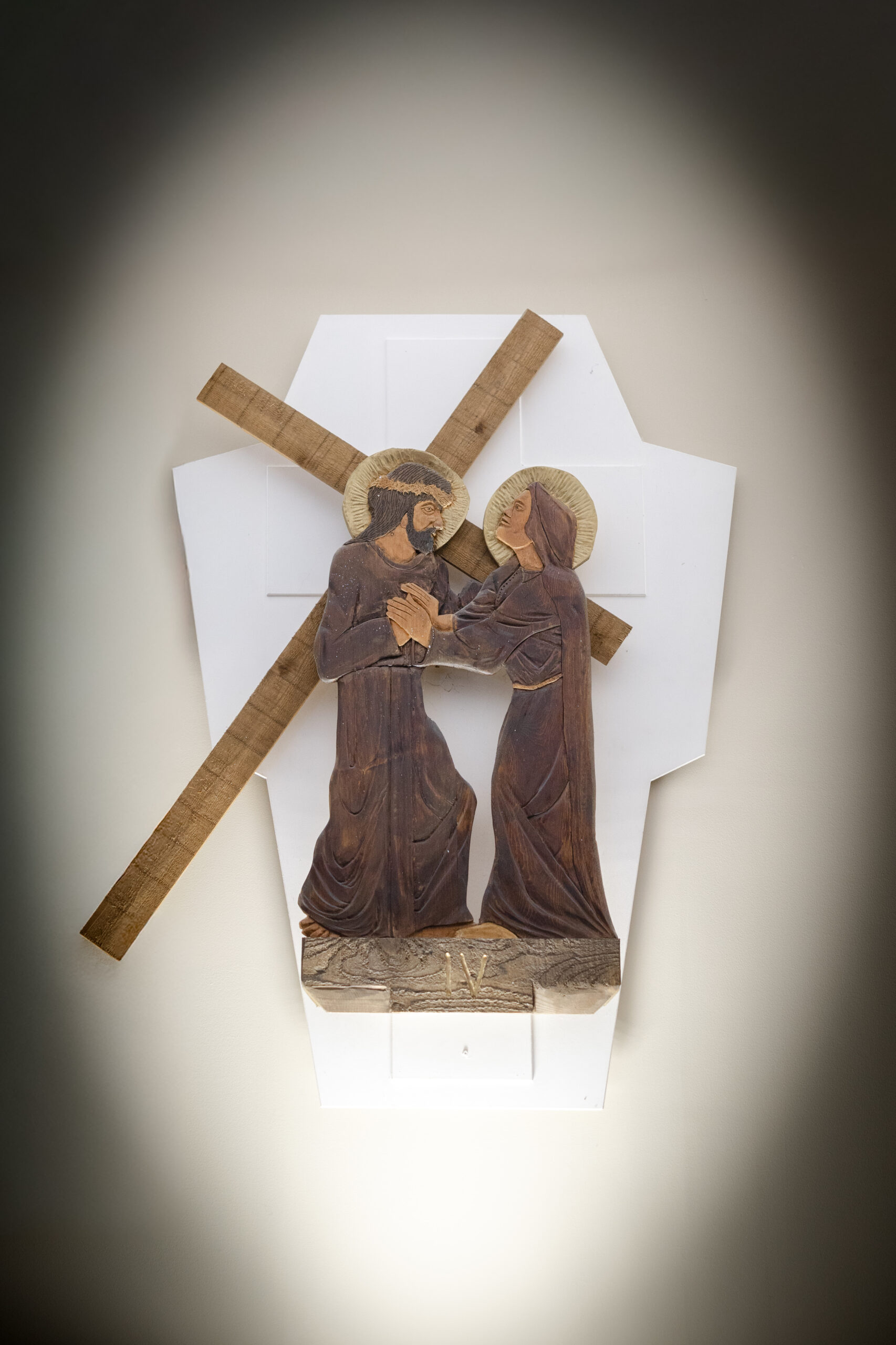
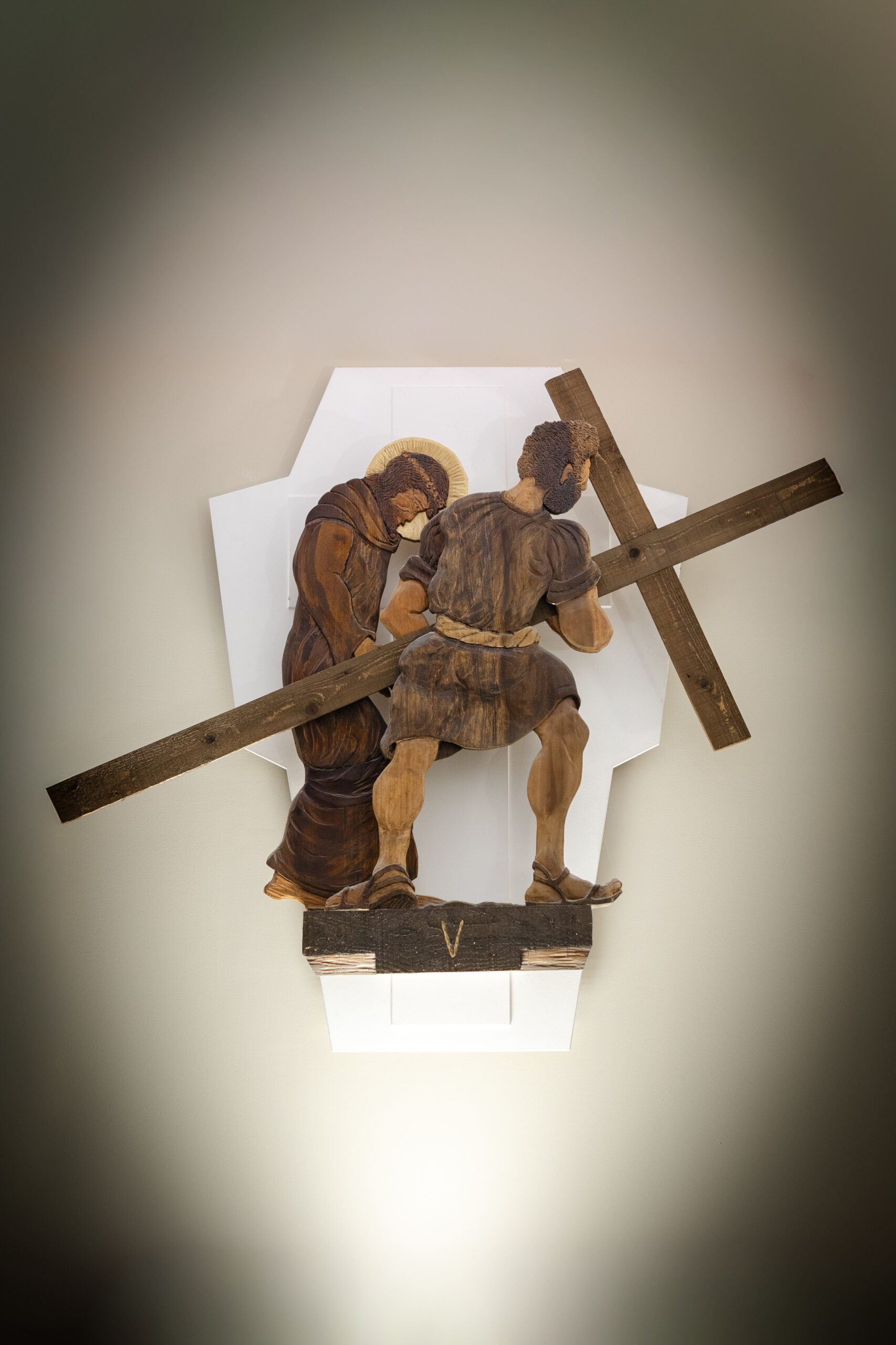
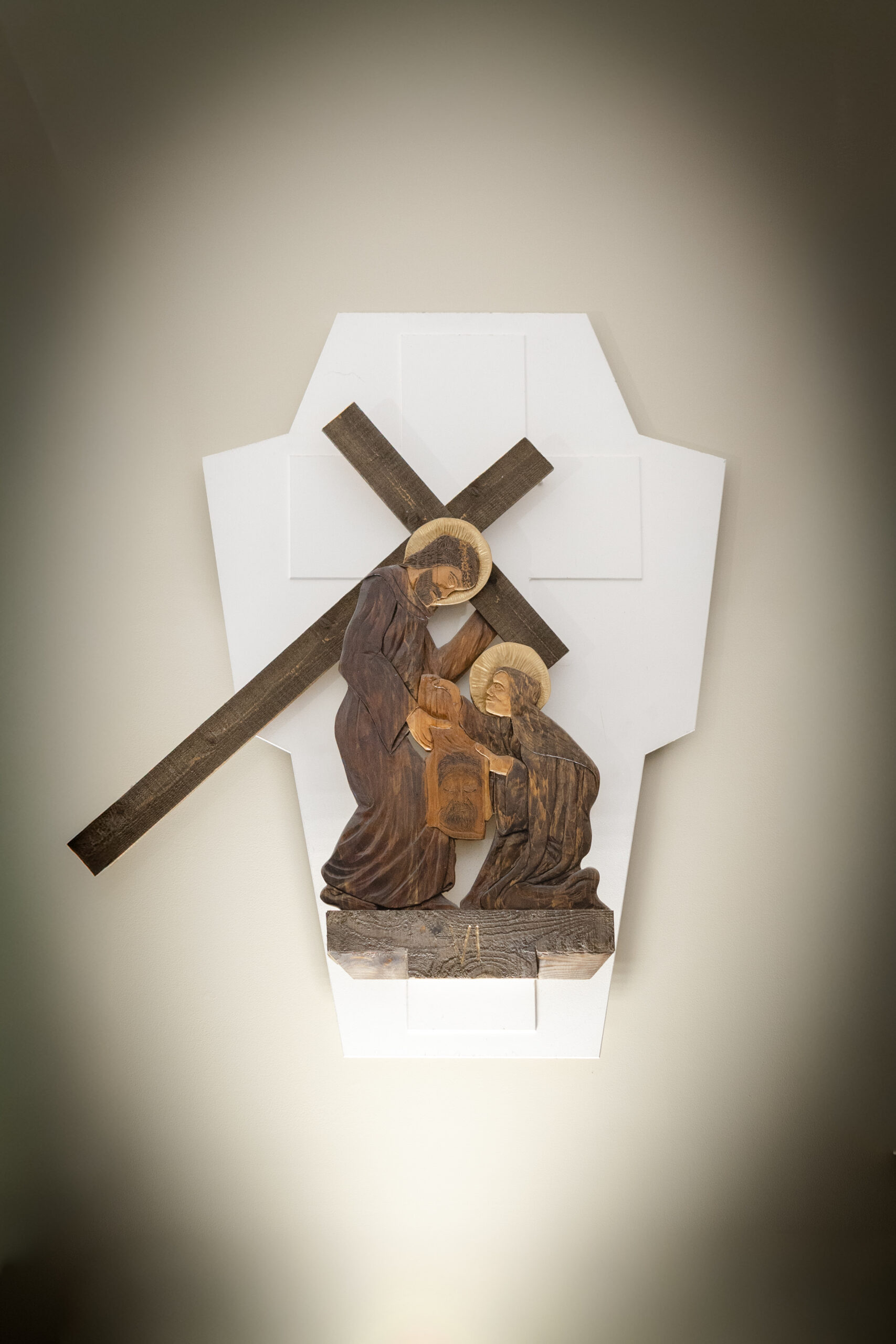
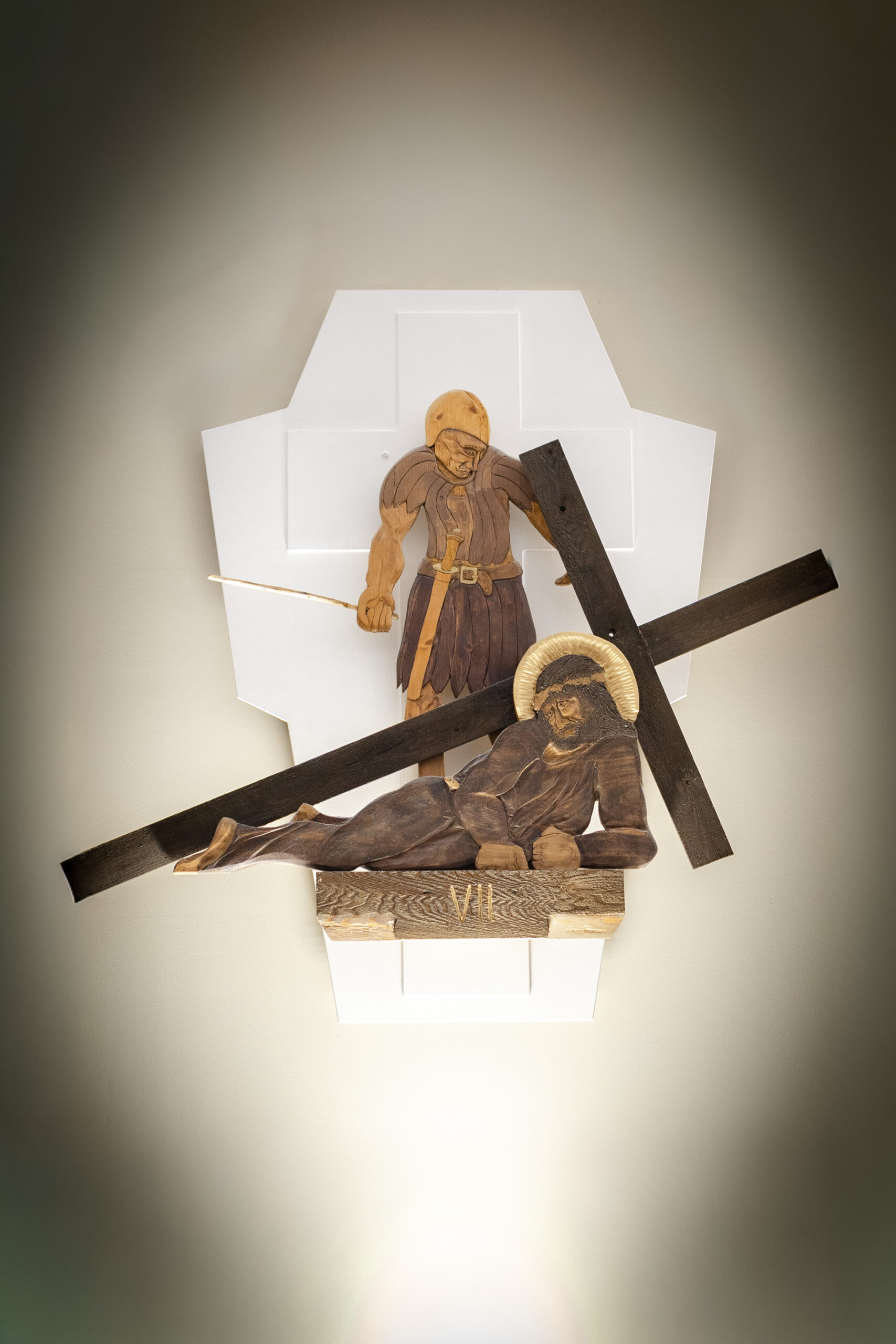
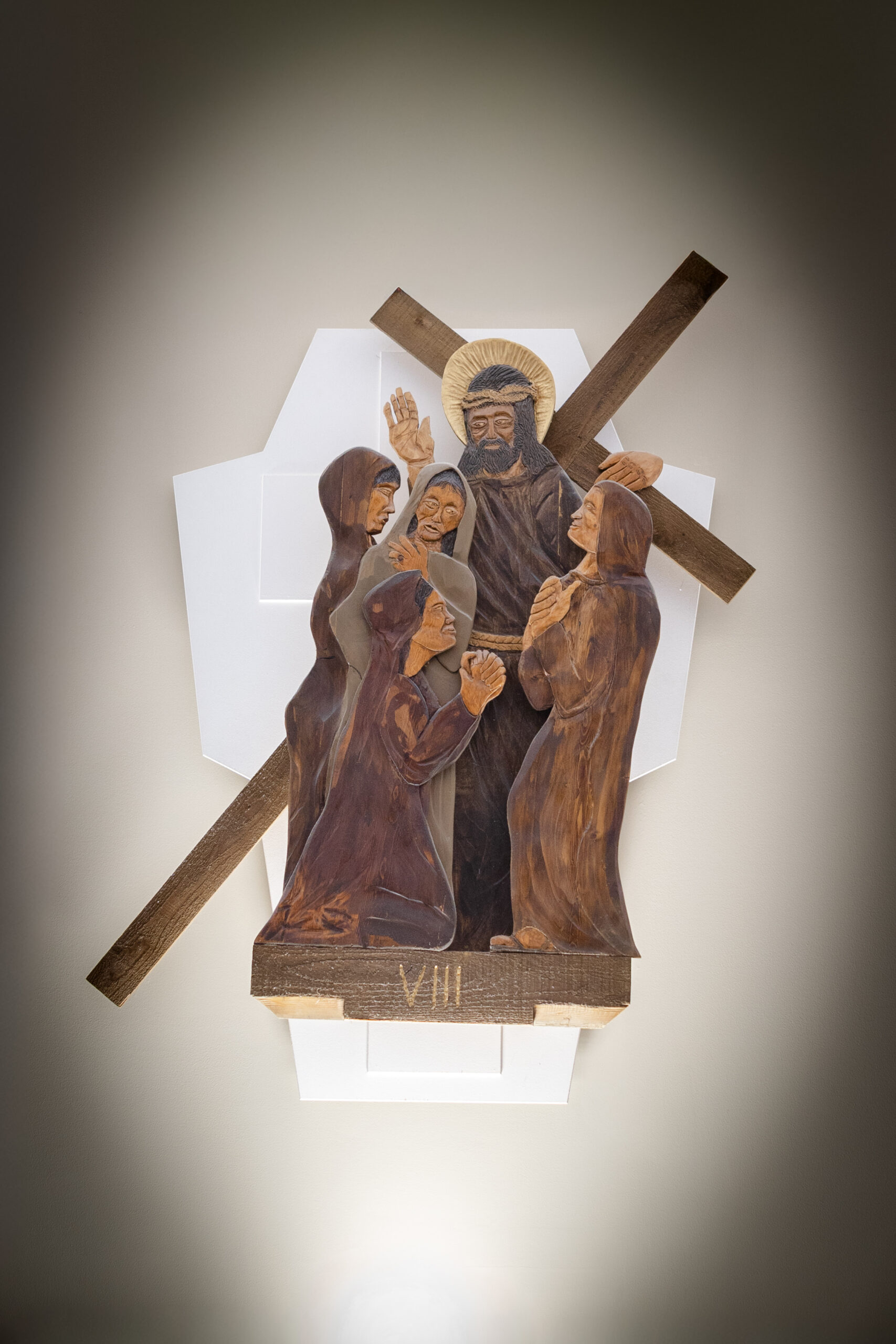
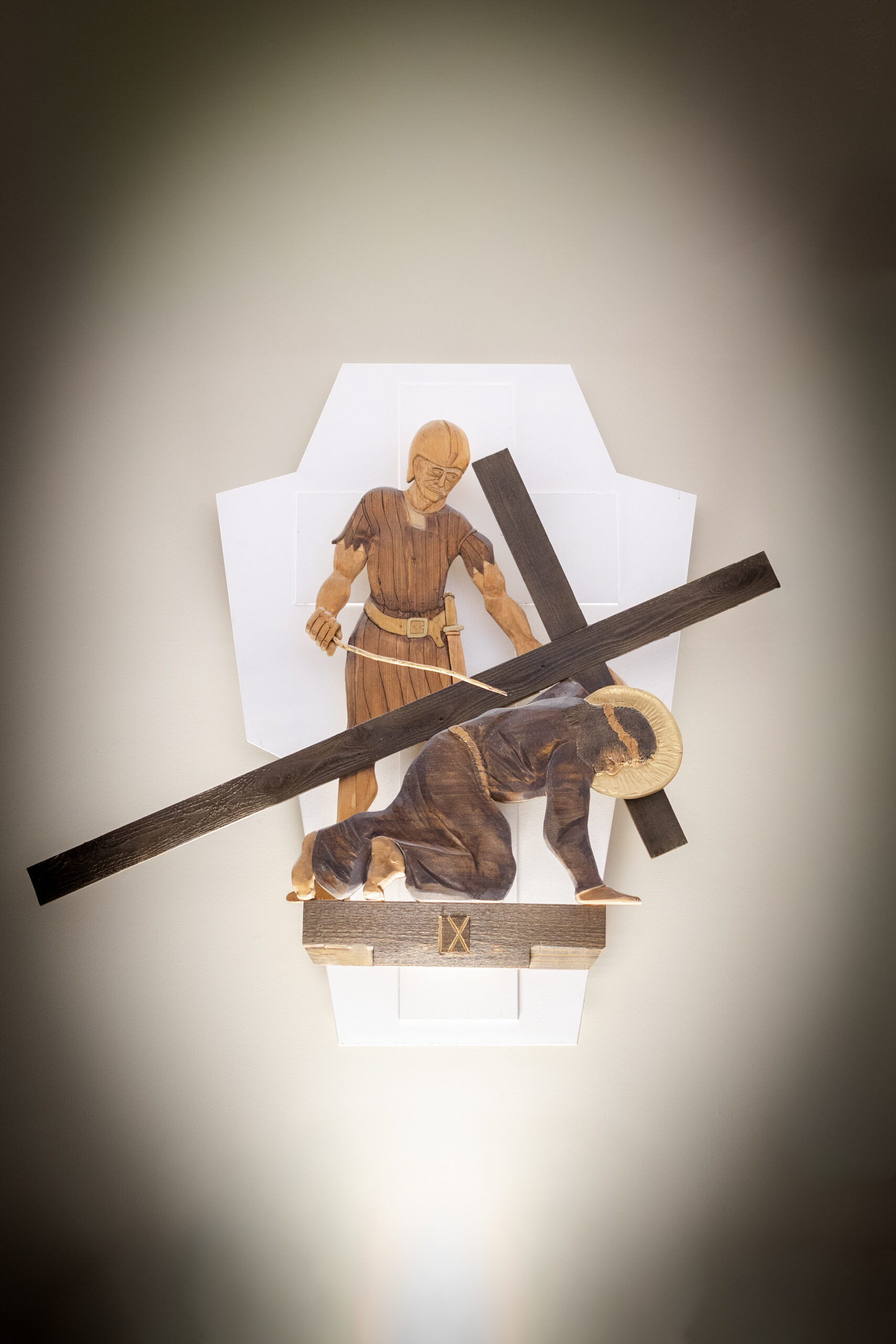
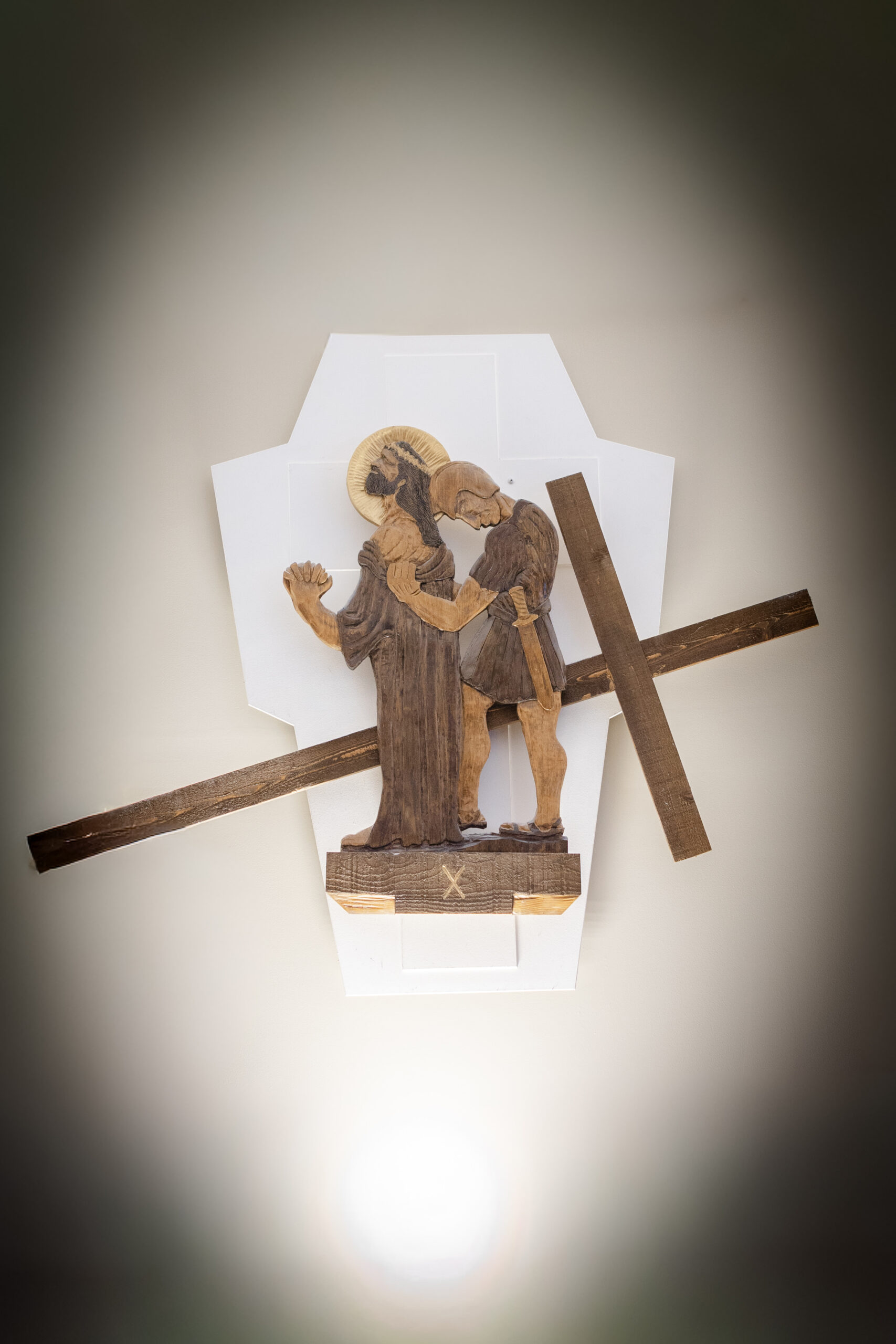


The following is an article from NC Catholics Magazine, March 2012, on the journey of creating these pieces of art:
On an unseasonably warm January day in Nags Head, NC, local artist Glenn Eure is sketching the Thirteenth Station of the Cross: Jesus is taken down from the cross. He is surrounded by friends who have volunteered as models, for Mary, the Apostle John, Joseph of Arimathea and Jesus. As he draws and tints his sketch with watercolors, Glenn asks advice from Father Bill Walsh, O.S.F.S., the pastor of Holy Redeemer Parish in Kitty Hawk, where Glenn and his wife, Pat, attend Mass.
The drawing is only a guide. In a few days Glenn will use it to carve from North Carolina tulip wood and poplar a Station which will hang this Lent in Holy Redeemer Church. It’s a process he knows well by now. A little over a year ago he completed all fourteen Stations for his church. “The thirteenth was smaller than the others, though,” he says, “so I’m redoing it.”
The task of creating the Stations for Holy Redeemer was one Glenn volunteered for. A painter and printmaker as well as a sculptor, the artist had just finished the Monument to a Century of Flight – dedicated in 2003 – when Father Walsh showed him pictures of the Stations the church was planning to purchase. “They had no feeling to them,” Glenn says. “I told Father Bill I could do better and it wouldn’t cost the church a dime.”
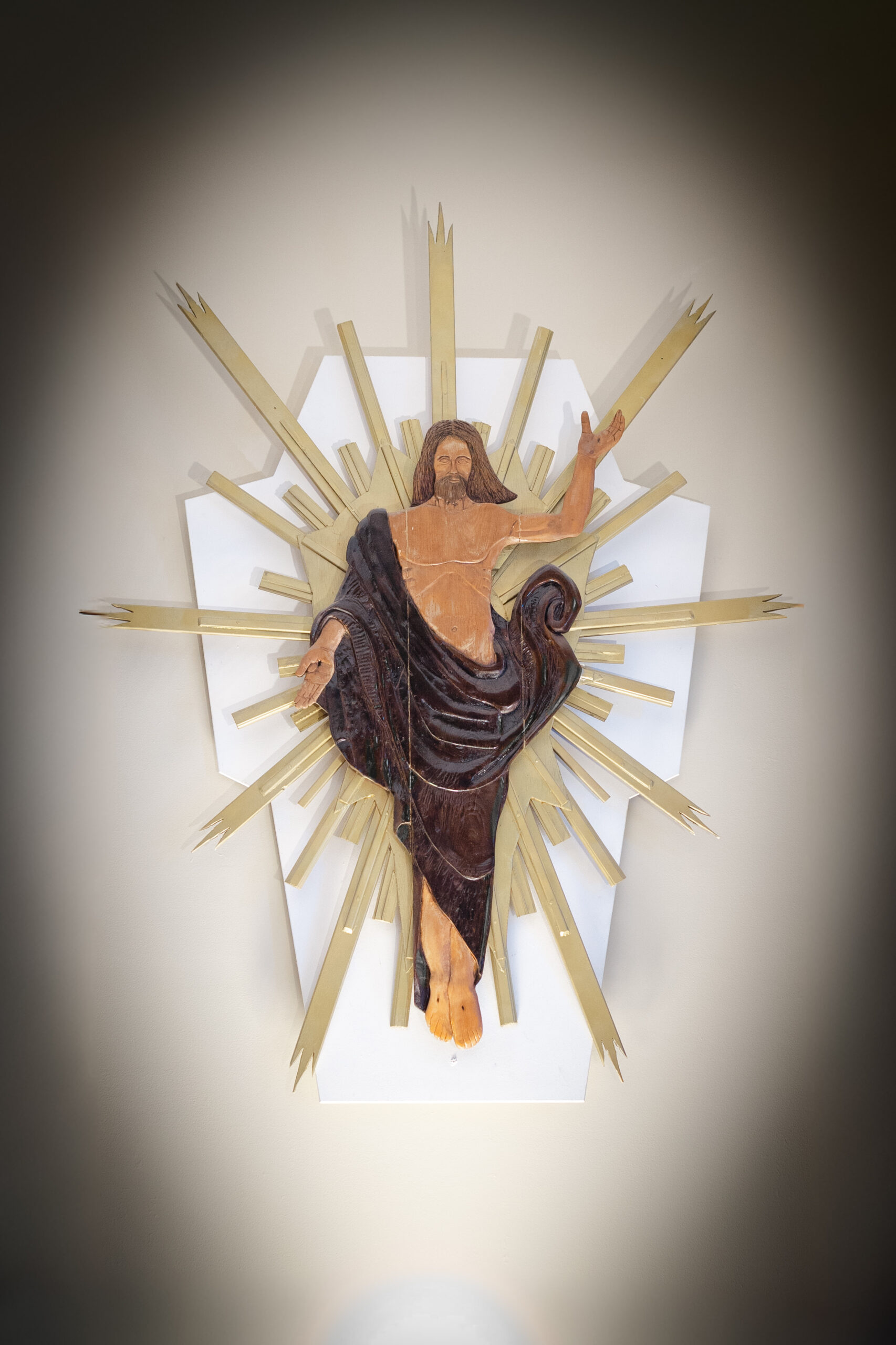
Today Glenn acknowledges, “I had no idea what I was getting into.” He began by carving the Resurrection. “That’s not one of the traditional stations,” he explains, but he saw it as a significant part of his plan. “You’d be surprised,” he says, “how often the Stations you see in churches have Jesus carrying the cross from right to left. So, when you’re praying them, you’re going against the flow. I wanted Jesus to be going left to right, and towards the Resurrection.”
“Perhaps it’s Glenn’s artistic instinct that gave him that idea,” Father Walsh says. “But it’s really a profound theological insight. Because of course the Way of the Cross is pointing to the Resurrection, to salvation.”
Glenn then set about carving the Stations in order. A few months into the project, though, he hit a psychological roadblock. The strenuous work of portraying so much pain each day may have dredged up some of the scenes Glenn had witnessed in his own life, particularly in the military. A retired army major and a veteran of two tours each in Korea and Vietnam (where he was wounded), he says, “I don’t know for sure what it was. I was having trouble sleeping. And for almost a year I just stared at the work. I couldn’t put my hands to it.”
Finally, the artist sought psychological help and eventually, he says, “They got me out of the doldrums.” The Stations required 150 hours each and took seven years from conception to completion. The work was “tremendously grueling” for a man in his 70’s.
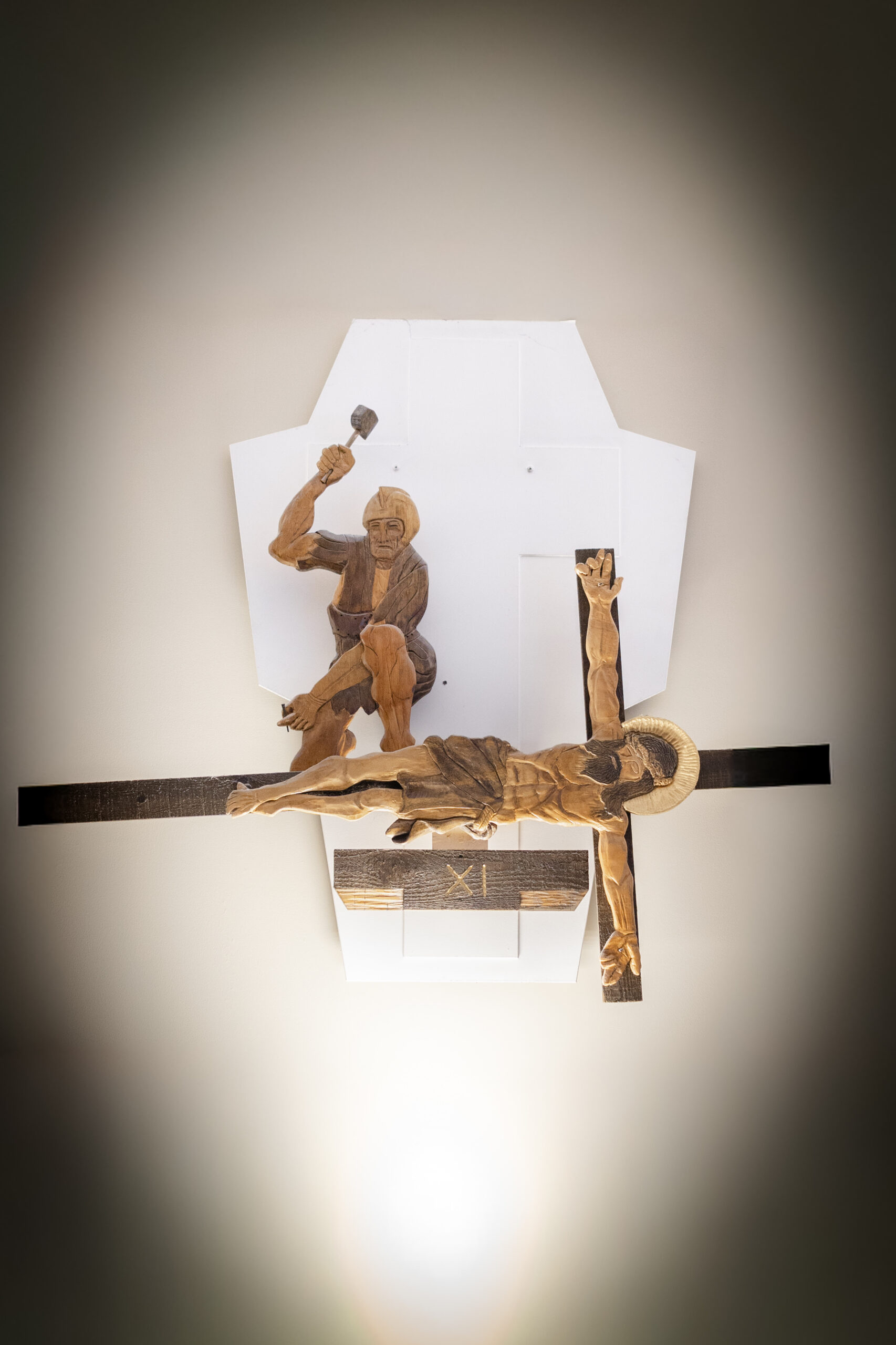
And the emotions evoked by the pain inflicted on our Savior were always just beneath the surface. Just beneath, until one Sunday when Glenn and Pat (his wife) were assembling the eleventh Station: Jesus is nailed to the Cross. “I had carved Christ and the cross separately,” Glenn recalls. “We had it all measured and up on the work bench, and I had found some square-headed iron nails to fix the body to the cross. But as I put the nails into the hands of the figure of Jesus I suddenly felt this surge of emotion right in my solar plexus and I had to pause. Pat noticed right away.” “He just turned ashen white,” Pat remembers. “It was incredibly emotional. Neither one of us could say a word. I wouldn’t want to go through that again.” “Any work of art includes pain,” Father Walsh has commented. “And a lot of suffering went into the work here. But Glenn kept going. It was a work of love.”
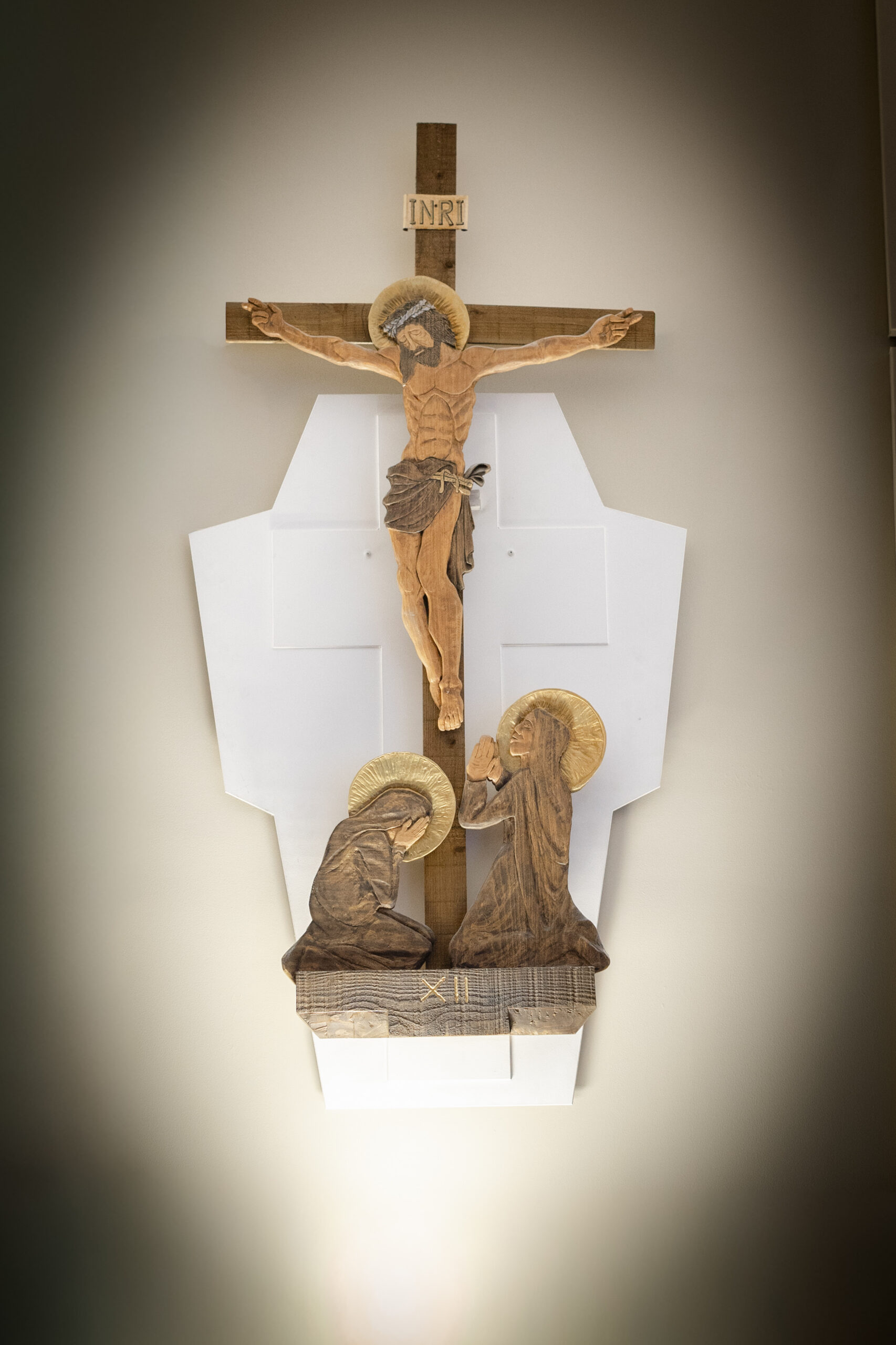
Glenn Eure’s Stations project not only brought the Passion home to the artist, but to dozens of the artist’s friends and fellow parishioners who modeled for him. Fr. Walsh posed for the Roman soldier in the ninth Station. Several members of the Holy Redeemer Parish staff were the “daughters of Jerusalem” in the eighth station. Many of the models felt that posing for the project – Glenn uses the models for physical positioning, the angles of arms and hands, “the essence of the subject,” rather than facial likeness – was a prayerful experience. “As a human being,” said one of the Holy Redeemer parishioners who modeled, “I am part of Jesus’ Way of the Cross. He did it for me. And when I go to Mass and look at our Stations, I’m reminded of that in a special way.”
Bishop F. Joseph Gossman dedicated Holy Redeemer Church in 2001 after the original church in Kill Devil Hills was destroyed by fire. When Glenn Eure’s Stations were hung and dedicated in January 2010, Father Walsh said that the construction of the church was finally complete. “We have a lot of visitors here,” the pastor says, “and more than a few of them have asked if the church was designed in such a way as to highlight the Stations. They are so perfectly integrated with the space.”
Glenn dedicated the work to his brother, whom he credits with bringing him back to the Church after he had been away. Glenn’s wife Pat, who was at his side throughout the struggle to complete the Stations, gives special credit to their pastor, Father Bill. “The stations happened,” she writes in an introduction to a booklet about the work, “because of one man’s faith not only in God but in his fellow man. Fr. Bill came from the Oblates of St. Francis de Sales to Holy Redeemer Parish at the same time that Glenn’s ideas for the Stations wanted expression. Accepting the inspiration of creativity and respecting the solemnity of each person’s journey with God, Father Bill’s only intrusions on the creative process were effervescent enthusiasm and a listening ear when summoned. He never doubted for one minute that the Stations would become reality. When there were obstacles, he prayed. You could say that Holy Redeemer’s Stations of the Cross were carved out of prayer – those of the priest, the artist, parishioners and friends.”
An excerpt from an address by the Holy Father Pope Benedict XVI after the Stations of the Cross at the Colosseum on Good Friday, April 2011:
“The cross is not the banner of the victory of death, sin and evil, but rather the luminous sign of love, of God’s immense love, of something that we could never have asked, imagined or expected: God bent down over us, He lowered Himself, even to the darkest corner of our lives, in order to stretch out His hand and draw us to Himself, to bring us all the way to Himself. The cross speaks to us of the supreme love of God and invites us, today, to renew our faith in the power of that love, and to believe that in every situation of our lives, our history and our world, God is able to vanquish death, sin and evil, and to give us new, risen life. In the Son of God’s death on the cross, we find the seed of new hope for life, like the seed which dies within the earth… “Let us gaze on the crucified Jesus and let us ask in prayer: ‘Enlighten our hearts, Lord, that we may follow you along the way of the cross. Put to death in us the “old man” bound by selfishness, evil and sin. Make us “new men”, men and women of holiness, transformed and enlivened by your love.’”